
by Joseph Stoutzenberger
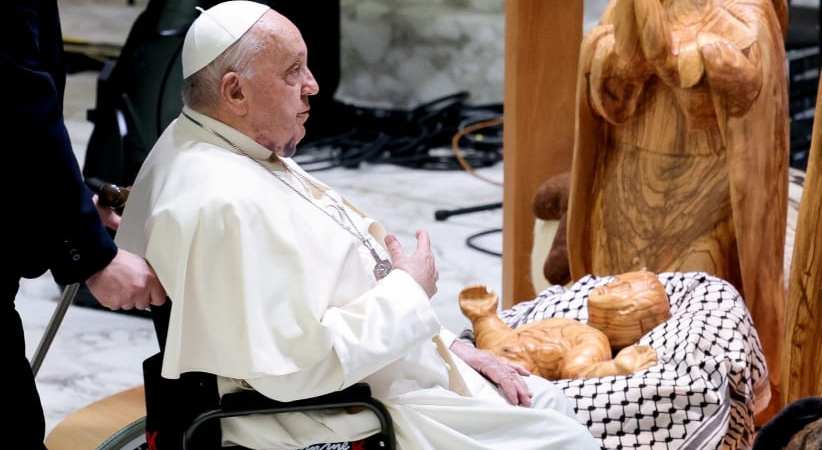
header image: Pope Francis holds an audience with donors of the St. Peter’s Square Christmas tree and Nativity scene, at the Vatican (photo credit: REMO CASSILI/REUTERS)
I was in Jerusalem seventeen years ago. A friend and I went looking for an ATM to withdraw money. Three blocks from our hotel, we came across a gas station where a young man was filling up his car. We asked him if he knew where we could find an ATM, and he told us there was one two blocks away and that he would gladly take us there. I hesitated and said we could walk, but at that point, it started to rain, so my friend jumped into the front seat, and I went in the back. On the seat next to me, I saw a keffiyeh, a red and white scarf worn by Palestinians at the time most often associated with the PLO, the Palestine Liberation Organization. I started imagining my friend and I being taken hostage and hidden away somewhere in an underground bunker. Sensing my uneasiness, the driver said, “Where are you from? I have a brother who lives in California.” His kind gesture got us to the bank and back to our hotel without our getting wet and without incident.
Symbols and images have power. Even without words, they can speak volumes. This past Christmas, the nativity scene at the Vatican featured baby Jesus sleeping on top of a keffiyeh. As powerful symbols can do, it caused quite a stir. For some people, the scarf (the word is related to the English “coif”) represents terrorism. For others, it represents identifying with a people whose roots go back to the Bedouins and others who live in rural, arid lands of the Middle East. Wearing one has also come to be a gesture of solidarity with those suffering under oppression and injustice, especially in Palestine. Hopefully, the pope’s decision to highlight the Palestinian people in this simple symbol led to some reflection on the historical background of the people living in Palestine and Israel and also expressed compassion for their suffering and oppression. Thirty years ago, Palestinians were mostly Muslim, but there were also Jewish and Christian Palestinians. Bethlehem itself had a substantial Christian population, and a number of Christian families there made a living creating hand-carved figures made of olive wood. Restrictions on movement between Palestine and Israel led to fewer and fewer Christian pilgrims going to Bethlehem, and most Palestinian Christians left. When I was there in the early two-thousands, only one store remained that sold olive wood nativity scenes and other Christian ornaments. The rest of Bethlehem’s main street stores were boarded up.

Image: Bedoin posing in the desert at Wadi Rum, Jordan
At the time of Jesus, the people living in Bethlehem, Nazareth, and Jerusalem were predominantly Jewish. In time, most of these people became Christian and then Muslim. Nonetheless, if Jesus were alive today, he would surely feel more at home among Palestinians, Israelis, Lebanese, and Syrians than he would, say, among people of Anglo-Saxon descent, even if they call themselves Christians. The Palestinian people are the people of Jesus. He would recognize that the Arabic word “Allah” is similar enough to his Hebrew and Aramaic and that it likely refers to divinity. The term “God” would be totally foreign to him. It’s highly likely that the newborn Jesus actually was swaddled in a keffiyeh of some sort, and as an adult, he no doubt wore such a scarf as he walked the dusty roads of Galilee. Pope Francis did not let the negative connotations that a checkered keffiyeh has for some people prevent him from using it to communicate a message of solidarity with and compassion for suffering people. He is reminding us that there are people today, in what we call the holy land, who are hurting and crying out for relief from their distress and lack of freedom. Two thousand years ago, on this same hallowed ground, the birth of Jesus represented peace on earth and goodwill to all. That message was first heard by shepherds tending their sheep, no doubt wearing the head covering still worn by the rural people of Israel and Palestine. The message of Jesus is universal, but it has a place of origin. Today, that land is scorched, and the people living there are suffering beyond comprehension.
On Christmas day, Pope Francis called for a “silence of arms,” especially in Israel, Palestine, and Ukraine. His heart goes out to victims of violence worldwide, including both Israelis and Palestinians. The birth of Christ, Prince of Peace, happened two thousand years ago, but his presence continues with the birth of every child who brings hope for a future of peace and justice. The pope recognizes that hope for the future is being snuffed out when Palestinian babies wrapped in swaddling clothes made of the cloth of a keffiyeh are victims of the destructive use of arms. His call for silencing weapons reflects Gandhi’s message found on his bust at the UN: “There is no way to peace; peace is the way.” The pope’s Christmas message, punctuated by the image of a little baby on a keffiyeh, is: Stop the killing. On all sides. Then begin the arduous, challenging task of creating peace and a just world in the place we call the holy land.
PS: On January 4, 2025, the Vatican removed the keffiyeh on which the statue of the infant Jesus lay after a number of prominent Jewish organizations expressed concern that it could lead to increased incidents of anti-Semitism.
 iPub Forum
[…] Christ in a Keffiyeh […]
LikeLike