
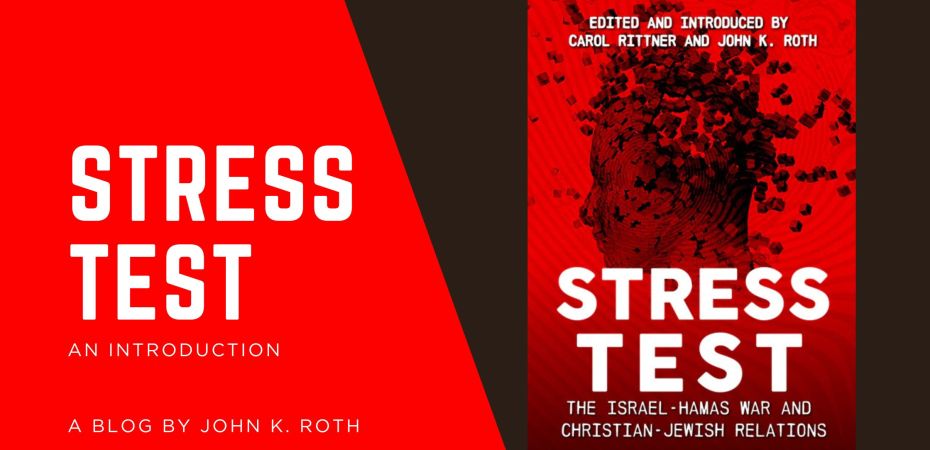
by John K. Roth
The longest section in Stress Test is the book’s Timeline. Here’s what the introduction and conclusion for the Timeline say:
On January 14, 2025, Israel and Hamas agreed to a phased ceasefire that may end the devastating war in Gaza, which started when Hamas attacked Israel on October 7, 2023. This timeline identifies major events in the Israeli-Palestinian conflict from 1945 to 2024. Its last entry, dated December 31, 2024, says that the Israel-Hamas war has damaged but not eliminated Hamas, killed more than 45,000 Palestinians and 1,700 Israelis, and displaced 1.9 million Palestinians and 100,000 Israelis.
As I worked on the book’s timeline, my bottom-line reaction was that it is a record of failure. Time and again, efforts have been made to resolve the Israeli-Palestinian conflict. None has been more than partly and temporarily successful. It may not be likely, let alone certain, that attempts in 2025 will be any different. American interventions by the Trump regime do nothing to improve that assessment. They include Trump’s proposal that the US should take over Gaza, his ultimatums to Hamas, his intention to send $4 billion more in weapons to Israel, and the arrest and detention of Mahmoud Khalil, a former Columbia University graduate student who had a leading role on campus criticizing Israel’s war in Gaza. In addition, Trump’s alliance with Israeli prime minister Benjamin Netanyahu increases the likelihood that Israel will annex some or all of the West Bank, crippling prospects for a two-state solution to the ongoing conflict.
Stress Test begins by saying that this book promotes dialogue. It does so by raising questions and focusing on challenges that need to be confronted by American Christians who are committed to advancing good Christian-Jewish relations amid the current Israel-Hamas war and its aftermath. Those relations comprise not only organizations and communities—including churches, synagogues, and temples—but also personal relationships, many of them deeply-bonded friendships. Interactions between Christians and Jews have a long and often troubling history, but since World War II, the connections have grown closer while embracing pluralism that respects diversity and difference. The Israel-Hamas war threatens to derail Christian-Jewish relations. To avoid that unfortunate outcome, Christians and Jews must engage clearly and candidly, critically and compassionately, about the war and its aftermath. As the book’s title – Stress Test – warns, the task is difficult.
Difficult? Wouldn’t impossible be a better word? At least if the assumption is that Christian-Jewish dialogue could make a positive difference in response to the Israel-Hamas war. None of the contributors to Stress Test are experts on international relations. Its authors are scholars who have no diplomatic credentials or powers. In addition, they know that the influence of Christianity and Judaism in the United States is declining. They understand that, however good Christian-Jewish relations may be, those relations have limited opportunities to change the world for good. Nevertheless, opportunities exist. Stress Test identifies some of the most important.
Christian-Jewish dialogue can bring diverse people together, especially in local communities. It can strengthen both traditions by sharing and multiplying their ethical commitments, including protest and resistance against antisemitism. Christian-Jewish coalitions, moreover, can be enhanced if their work includes Muslims, excludes anti-Palestinianism, and insists on a two-state solution for the Israeli-Palestinian conflict. Christian-Jewish relations will also be strengthened by rethinking how the Holocaust should and should not be pivotal within them. The Holocaust recedes into the past but must not be forgotten. As generational changes take place in an increasingly globalized world, that catastrophe is not at the top of everyone’s mind, but it deserves a place in everyone’s moral education about the differences between right and wrong, justice and injustice. That role entails diligence in Christian-Jewish relations to avoid instrumentalizing the Holocaust to legitimate war that destroys defenseless civilians. If memory of the Holocaust does not stir concern for the vulnerable, it fails. Making a start in responding to such concerns, Stress Test suggests how much more work needs to be done.
An American philosopher who is also a Protestant Christian, I call my chapter in the book “Making the Best of What We Have.” It says that if my post-10/7 contributions to Christian-Jewish relations are to bridge divisiveness and be significantly constructive, I must stress-test my identity by probing what it means to call myself—as I currently do—a pro-Palestinian Zionist. That stance entails three affirmations:
- Israel has the right to exist and defend itself as a Jewish democratic state
- The Israeli carnage against Palestinians in Gaza must stop, and that region must be rebuilt
- A just two-state solution to the Israeli-Palestinian conflict is paramount, and the United States has important responsibilities to help achieve that goal.
I take Zionism to mean self-determination and statehood for the Jewish people in Israel, their ancestral homeland. Especially in the context of the Israel-Hamas war, my pro-Palestinian Zionism raises persistent questions. They include issues provoked by the Holocaust survivor, Sarah Kofman, a Jewish philosopher who argued that “no community is possible with the SS.” The stress test I face as a pro-Palestinian Zionist, the challenge confronting Christian-Jewish relations amid the current Israel-Hamas war and its aftermath is this: With whom can I and must I have community and with whom can I and must I not?
My pro-Palestinian Zionism means that no community is possible with Hamas—unless Hamas profoundly changes its anti-Zionist position. My pro-Palestinian Zionism also means that no community is possible with Benjamin Netanyahu and his right-wing government unless they make changes that seem unlikely at best. Nor can I find community with Americans—Christians or Jews—who keep bending the knee to Netanyahu and his crimes-against-humanity policies, or with advocates of Palestinian nationalism that seek control, even metaphorically, “from the river to the sea.”
Instead, I must make community with those—especially fellow Americans—who work to end the war, support replacing Netanyahu and his ilk with more inclusive Israeli leadership, relieve Palestinian suffering, rebuild Gaza, and pursue a just two-state initiative that has a chance, even if only a modest one, for success. My pro-Palestinian Zionism may make it impossible to have community with some Christians and some Jews—personally and organizationally—but I know that friends and allies exist and that the best future for Christian-Jewish relations depends on my standing in solidarity with them and expanding that much needed community as much as possible. Making the best of what we have requires me—and others, I hope—to move in those directions.
John K. Roth, the Edward J. Sexton Professor of Philosophy Emeritus at Claremont McKenna College, founded the Center for the Study of the Holocaust, Genocide, and Human Rights. He publishes extensively on these topics, and as a committed Protestant Christian, he fosters Christian-Jewish collaboration against authoritarianism. He has received numerous awards, including the U.S. National Professor of the Year in 1988. His recent book Stress Test is now available!
 iPub Forum