
By Rabbi James Rudin
Header image credit: Wikipedia
Historically, the election of a Catholic US President or an American Pope is a very rare event.
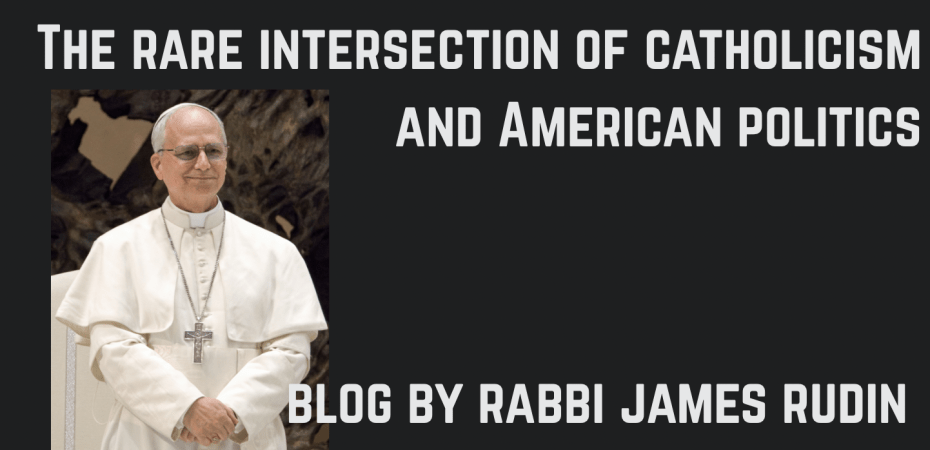
And because the recently elected leader of the Roman Catholic Church was born in Chicago and is reportedly a White Sox fan, he will easily understand “the score” is now only two Roman Catholic US Presidents (John F. Kennedy in 1960 and Joe Biden in 2020) and just one American-born Pontiff (Robert Prevost/Pope Leo XIV in 2025).
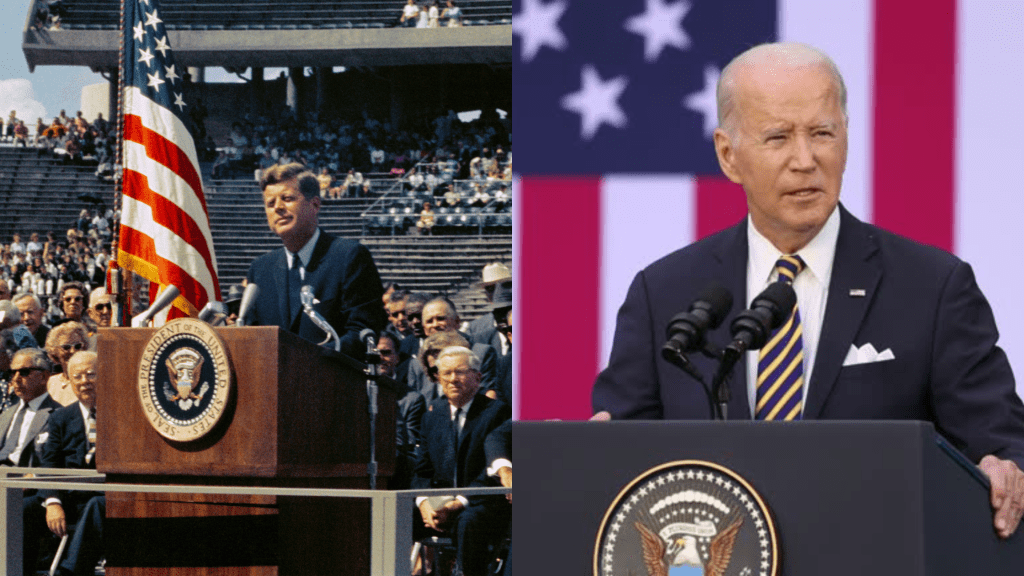
Image credit: (left) President JFK by NASA CCO Images. (right) President Joe Biden by Sean Gallup | Credit: Getty Images
While JFK and Biden were winning candidates, two other Catholic presidential nominees came up short in their election campaigns to reside in the White House: New York Gov. Alfred E. Smith in 1928, and U.S. Senator John F. Kerry in 2004.
Smith unsuccessfully ran against U.S. Commerce Secretary and Republican Herbert C. Hoover. Back then, the religious bigots publicly charged that the New York governor’s religious loyalty to Pope Pius XI superseded his faithfulness to the Constitution and made him unfit, even dangerous, to sit in the Oval Office.
The obscene anti-Catholic attacks on Smith came not only from members of the anti-Catholic, antisemitic, and anti-African American Ku Klux Klan and other hate groups. There were also strong anti-Catholic feelings deeply embedded among the clergy and laity of many Protestant denominations, including the Southern Baptist Convention and the Methodist Church.
In addition, the New York City-born Smith spoke with a “Brooklyn accent,” was a fervent “wet” (a foe of Prohibition), and was particularly alien to many voters in white rural America.
Some bigots spread the rumor that Pope Pius XI had literally packed his bags and was planning to move into the White House if Smith became president. Such attacks reflected the widespread belief that Catholic politicians were not free from total Vatican control on all public policies.
Smith replied in anger:
“I recognize no power in the institutions of my Church to interfere with the operations of the Constitution … or the enforcement of the law of the land. I believe in the absolute freedom of conscience … in the absolute separation of church and state. … I believe that no tribunal of any church has any power to make any decree of any force of law of the land, other than to establish the status of its own communicants within its own church.”
Many religious leaders spoke out against the anti-Catholicism of the day, none more forcefully than Rabbi Stephen S. Wise, the most prominent Jewish leader of that era. He repeatedly assailed the anti-Catholic hatred hurled at Smith: “Religious bigotry is engulfing the nation … my answer was … to remember that America meant a new start in the life of the world. If America meant to me nothing more than a perpetuation of the past, then the promise of America would come to naught.” The rabbi campaigned hard for his friend, Smith.
Three weeks before the election, Wise delivered a nationwide radio address supporting Smith. The rabbi attacked religious prejudice and urged voters to live up to the highest ideals of fairness and justice when they cast their ballots.
However, the 1928 election was a landslide victory for Hoover. Smith carried only eight states and won but 40% of the nearly 37 million votes cast. Surprisingly, Smith narrowly lost his home state of New York, despite having been elected governor four times in a row.
But even in defeat, Smith established the electoral foundation of a long-lasting Democratic urban coalition by winning 12 of the country’s largest cities. His strongest support came from recent immigrants, including those from Ireland, Italy, Greece, Judaism, Poland, and Russia, as well as the few African Americans who were able to cast a ballot in 1928.
Wise consoled his friend after the election:
“… you made a brave fight … I shall always remember with joy and pride that I fought … under the banner of your leadership … A happier day for America may yet dawn.”
The rabbi was correct. Four years later, another New York governor, Franklin D. Roosevelt, building upon the ruins of Smith’s loss, soundly defeated Hoover and the Republicans. The GOP did not win another presidential election until 1952, and eight years later, JFK, despite the anti-Catholic attacks led by the Rev. Norman Vincent Peale and others, was elected president.
In an ironic twist of history, Jimmy Carter, a devout Southern Baptist, warmly welcomed Pope John Paul II to the White House as president in October 1979. An observer wryly remarked that the Polish-born pope did not bring his luggage with him on the visit.
Of course, it is unlikely Pope Leo XIV will “move into the White House” if he visits the United States. Why would he do that when he can see his White Sox play in the South Side of Chicago, a city where millions of fellow Roman Catholics live? And, perhaps most importantly of all, Chicago can offer its papal native son lots of authentic deep-dish pizza, a well-known culinary specialty unique to the “Windy City.”
Who, even a pope, could ask for anything more?
Editor’s Note: This blog was originally published by Religion News Service.
 iPub Forum