
by Harold Kasimow
Header image credit: Lisa Maree Williams/Getty Images
Jorge Mario Bergoglio, better known as His Holiness Pope Francis, was one of the most compassionate popes, deeply concerned with all people, especially the Jewish community.
I compare him to Pope John XXIII (1958–1963), who saved many Jews during the Holocaust. Rabbi Abraham Skorka, also from Francis’ home country of Argentina, became one of his closest friends over the years. They wrote to each other as “my dear brother,” and Skorka was one of the first people to be called by the pope after his election to that role. Over the many years that they were friends, they wrote a book together, “On Heaven and Earth.” Skorka told me, when he visited Grinnell, that he gave Francis a number of Rabbi Abraham Joshua Heschel’s books and Heschel often came up in their conversations.
Even 50 years after his death, Rabbi Abraham Joshua Heschel remains one of the most influential spiritual leaders in interfaith dialogue, mainly American Jewish-Christian relations. I can’t be certain of his influence on Francis, but many of his key ideas have a strong affinity to those of Francis. For example, in the first paragraph of Heschel’s classic book “God in Search of Man,” he writes, “When faith is completely replaced by creed, worship by discipline, love by habit; when the crisis of today is ignored because of the splendor of the past; when faith becomes an heirloom rather than a living fountain; when religion speaks only in the name of authority rather than with the voice of compassion — its message becomes meaningless.” This passage by Heschel, which warns against doctrine becoming more important than empathy, embodies the papacy of Francis. Additionally, one of Heschel’s most significant ideas about biblical thought is his theology of pathos. When he was writing his dissertation, Heschel developed the idea that God needs human beings — that God encounters us before we encounter God. Francis shared the same idea when he said, “God is first; God is always first and makes the first move.”
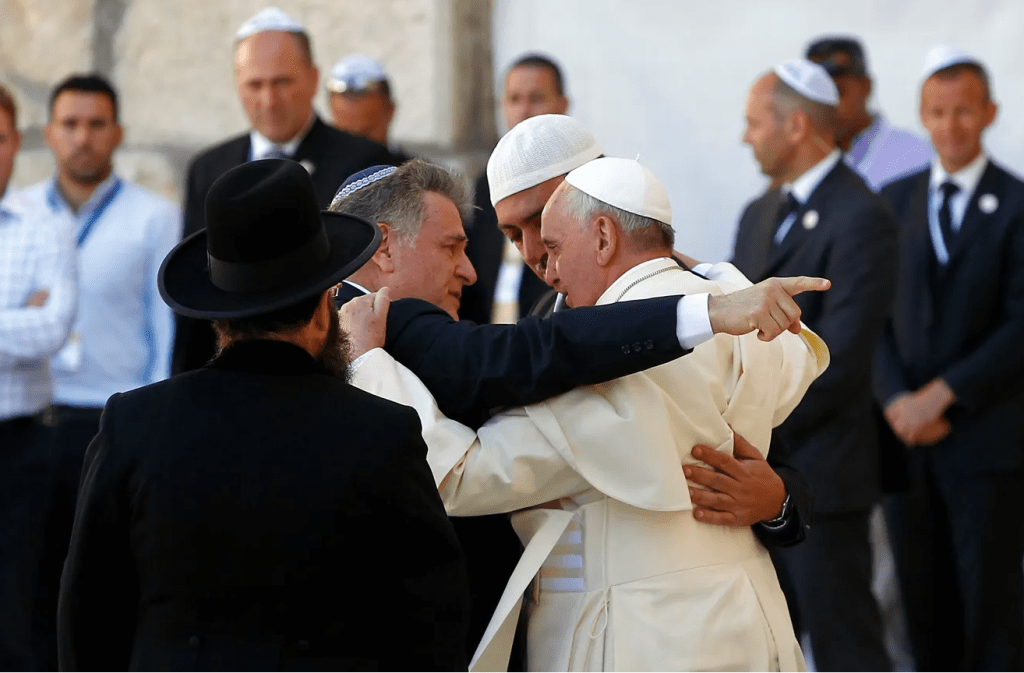
Pope Francis hugs Rabbi Abraham Skorka (second from left), and Omar Abbound, director of the Institute for Religious Dialogue in Buenos Aires, during the pope’s visit to the Western Wall, Judaism’s holiest prayer site, in Jerusalem’s Old City on May 26, 2014. The three were friends from when Francis was a cardinal in his native Argentina. IMAGE CREDIT: REUTERS/Ronen Zvulun.
When I met Francis in 2018, we had a brief, informal conversation. Francis asked me to pray for him. Meeting Francis deepened my admiration for him due to his exceptional humility, his profound commitment to the poor and the environment, as well as his desire to bring healing among the world’s religions, which is more critical for peace than ever before. He devoted a great deal of energy to interfaith dialogue, particularly his efforts to promote peace between Israelis and Palestinians. His boundless compassion and love for all people, especially the poor, were truly inspiring. The audience with him was a very special moment for me because of his deep warmth, as if the sun was shining from his face to mine.
Like Pope John Paul II, when he traveled, Francis met with members of other traditions, including Jews and Muslims. He was the first pope to visit the tomb of Theodor Hertzl. Of the many meetings that he had, the meeting that stands out for many Jews was his visit to the synagogue in Rome on Jan. 17, 2016, where he noted that over 1,000 members of the Jewish community in Rome were deported to Auschwitz on a day in October 1943: “Today, I would like to remember them in a very sincere way: their suffering, their anguish, their tears, must never be forgotten. The past must serve as a lesson for us in the present and in the future.”
Judaism and Christianity are distinct religious traditions with conflicting claims to truth. The aim of dialogue is not to bring both parties to the same conclusion, but rather to continue listening to each other. In their dialogues, Rabbi Abraham Skorka and Pope Francis did not always agree. But Skorka agreed with the following statement made by Francis, “Friendship can only be achieved by walking together. Knowing how to dialogue and respecting each other’s position. Fighting like brothers and reconciling like brothers — it’s an existential journey. I believe that God, who is the Father of all of us, wants it this way.”
Francis had great affection for his Jewish sisters and brothers. May his memory be a blessing.
Editor’s Note: This article was originally published by the Des Moines Register on May 4, 2025.
Harold Kasimow, George A. Drake Professor Emeritus of Religious Studies at Grinnell College. He is the author of Love or Perish: A Holocaust Survivor’s Vision for Interfaith Peace, and he has also written and edited several other books, including The Search Will Make You Free: A Jewish Dialogue with World Religions, Interfaith Activism: Abraham Joshua Heschel and Religious Diversity, and No Religion Is an Island: Abraham Joshua Heschel and Interreligious Dialogue with Byron Sherwin. He also edited special issues of Shofar: An Interdisciplinary Journal of Jewish Studies on Heschel and on Judaism and Asian Religions. Learn more about Harold here.
 iPub Forum