
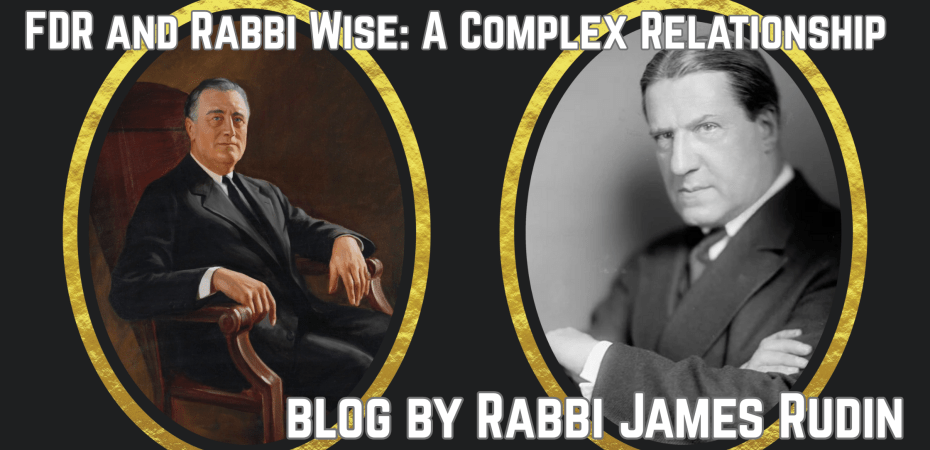
by Rabbi James Rudin
Header image photo credit for Rabbi Stephen Samuel Wise: Harris & Ewing
President Franklin D. Roosevelt (FDR) passed away eighty years ago, but debates about his historical legacy have only intensified with the passage of time.
Whenever I speak publicly about FDR’s close relationship with Rabbi Stephen S. Wise, the leader of the American Jewish community during the 1930s and 1940s, there is always a heated debate among audience members that can be summed up in just four words: “Roosevelt and the Jews.”
FDR’s many critics say the leader of the world’s most powerful country failed to use his extraordinary political capital to take lifesaving presidential executive actions that would have countered, perhaps even prevented, the Nazis’ mass murder of more than six million Jews between 1933 and 1945, the same years FDR was President.
Roosevelt’s detractors claim that behind his jaunty demeanor, broad smile and omnipresent cigarette holder was a “closet antisemite” who failed to open wide the American gates of entry for Jewish refugees who desperately sought to escape the Nazi mass killing machine in Europe.
And there is always this counterargument: FDR, after his election in 1932, faced the devastating Great Depression, strong anti-immigrant feelings, and a virulent antisemitism fueled by Catholic priest Charles Coughlin’s obscene weekly radio broadcasts and the anti-Jewish speeches of aviator hero Charles Lindbergh.
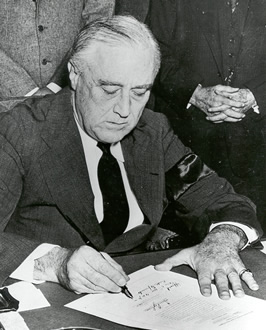
Image credit: Franklin D. Roosevelt Library
This side further argues that beginning in 1941, Roosevelt, as a brilliant commander in chief, successfully led a vast global military campaign that defeated not only Nazism, but fascism and Japanese militarism as well. FDR supporters claim that during the late 1930s, he carefully and skillfully prepared America for war against totalitarianism through a series of adroit actions, including a peacetime military draft and a “lend-lease” program that militarily strengthened a beleaguered Great Britain.
There is little shared ground between these two polar positions regarding our nation’s 32nd president, who was elected four times and died in April 1945, a month before the defeat of Hitler’s “Thousand-Year Reich.”
At the epicenter of this intense debate is the controversial relationship between Wise and FDR. The two leaders were New Yorkers, politically astute, superb orators, Ivy League graduates, and charismatic, larger-than-life figures with millions of devoted followers.
In their thirteen face-to-face meetings when FDR was president, Wise constantly urged Roosevelt to save human lives by overriding the 1924 immigration law that severely restricted the number of Jewish refugees who could enter the U.S. In addition, Wise sought a full-throated presidential commitment to the establishment of a Jewish state in the biblical land of Israel.
The rabbi did not achieve either of these goals. At a 1943 White House dinner, FDR asked Wise’s daughter, who was a guest of the president, to convey his “affectionate regards” to her famous father. Wise was not impressed. He lamented: “If only he would do something for my people.”
But Wise, like FDR, is not immune to criticism.
In 2008, speaking as president of the Hebrew Union College-Jewish Institute of Religion, Rabbi David Ellenson said: “In the 1930s, it was Wise who led the rallies against Hitler, so why did he fail so horribly in the 1940s?” Ellenson’s answer was that Wise had an “absolute and complete love” for FDR, and that “helped blind him” to the need for more activism.
Ellenson was echoing an ancient Jewish teaching that warns: “Be careful with the leaders of government, for they befriend a person only for their own needs. They appear to be friends when it is beneficial to them, but they do not stand by a person at the time of his distress.” I believe Wise was, like many others throughout American history, blinded by the seductive aura of possessing personal access to a President.
Could another American Jewish leader have been more successful in persuading FDR to abandon his rigid position on rescuing Jews and gain the president’s unequivocal support for a Jewish state?
We will never know. That turbulent era and the issues Wise faced in his encounters with FDR are now history.

Rabbi Stephen Wise speaks to the media. (Date unknown) Photo courtesy of Stephen Wise Free Synagogue Archives
But even when we recognize the hostility and obstacles that Wise faced in those terrible years, I will never understand or forgive his lack of courage and his inability to transcend, even sacrifice, his coveted solo leadership position for a larger goal: the need to save human lives.
Wise was unable or unwilling to accept the reality that no one leader, no matter how gifted, is indispensable or has a monopoly on wisdom, courage, and strength.
To whom much is given, much is expected. Because the Jewish people gave Wise their precious trust and love, they had the right to expect much more from him. Did they receive that kind of selfless leadership from Stephen Wise during the dark years of the Holocaust?
The answer is no.
 iPub Forum