
by Ann Marie Bahr
The USA desperately needs a commons for our civic life—a place where we can gather not with the like-minded, but with our neighbors and fellow citizens of various persuasions. A place where we can talk about the future of our towns, our state, the nation, and the world, and do so with open minds seeking a common good rather than as committed ideologues. A place where we can build on each other’s insights to forge an agreement that is better than any of our current ideas, rather than settling for a compromise that slices off parts of every proposal in order to find the least common denominator.
One of the most delightful oddities of Vermont is the ability of Vermonters to value both common sense and “book learning.” Vermonters are nothing if not practical—we have to be hardheaded realists in order to deal with the rigors of Vermont’s weather, terrain, and fiscal limitations. Yet we are also consistently ranked as one of the most highly educated states. This combination of practical wisdom and higher education may explain why we have a more functional public life than many other states.
Until very recently, many of Vermont’s colleges and universities had a strong liberal arts focus. Even beyond college classrooms, Vermonters value art and literature, music and drama, science, history, and libraries. These things are closely associated with a liberal education, which is commonly defined as a broad education including natural sciences (e.g., biology or chemistry), social sciences (e.g., sociology or economics), the humanities (e.g., history or languages,) and the arts (e.g., music or visual arts).
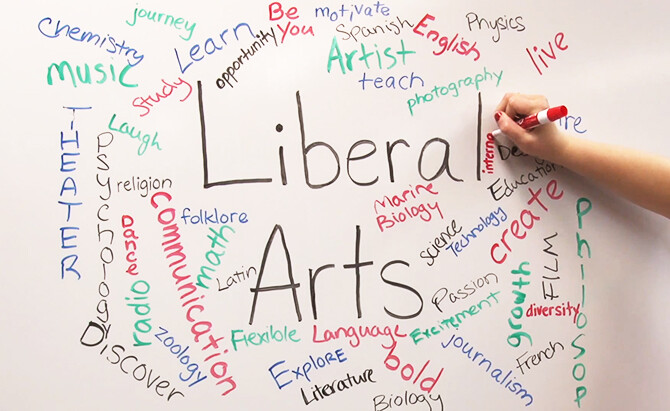
Image credit: Jim R. / LinkedIn
The liberal arts tradition is the form of education designed to support political life in a democracy. In our democratic republic, politics is the art by which a group of people defines both their common good and the route by which they hope to attain it (rather than having those things defined for them by a king or other head of government). I am concerned that we are losing this form of education and the democracy that it supports. We are rightfully concerned about the economic future of our youth, but that is only one part of what constitutes a good life. The natural and social sciences, the humanities, and the arts are the bedrock for fruitful discussion of the problems faced by governments. Yet today’s politicians and their followers often appear to lack knowledge of how science works, of the history of Israel and Palestine, of the foundational documents of America like the Constitution, of the role of religion in public life, of the lessons of history, or of how great literature and public speeches can inspire a nation to remember its core values. Students are being forced to launch into a career without having spent time examining the purpose of their life, what constitutes real happiness, how we should live our lives, or any of the other philosophical questions that help individuals define their values and find the profession in which they can best serve others. The fact that many Americans find no value in the liberal arts says more about our nation’s lack of values than it does about the supposed lack of value in the liberal arts.
A liberal arts education exposes students to different ways of thinking about issues. It integrates knowledge from many different disciplines. True, a person may be able to land a lucrative job without this breadth and integration of knowledge. It is also true that professional expertise is necessary for implementing solutions to practical problems. However, although such expertise enables us to reach our goals, it does not enable us to define our goals. Defining our common good and finding the path toward attaining it is the work of the liberal arts.
The fruit of a liberal education should be openness to genuine alternatives, to deeper reflection, to new information. It is evaluating opinions based on best current knowledge rather than on their match with one’s pre-existing views. Without these habits of mind, education becomes indoctrination, and civic life devolves into an irresolvable war of opposing echo chambers.
A strong liberal arts curriculum will provide the foundational knowledge for public discussions by giving citizens a common reservoir of facts. But it is not just the content of liberal education that matters. The process is equally important. At least in my (ancient!) experience at a liberal arts university, it featured discussion and essays. It involved questioning authorities without losing respect for them, disagreeing with your classmates while remaining friends, probing alternatives to see whether something was actually said and/or whether you actually understood what was said—these things prepare one for working together as opposed to preparing one to defeat those with whom you disagree. I am not talking about openness to misinformation or shallow thinking—such gullibility should be quickly dismissed thanks to the knowledge base provided by each course and training in critical thinking. The fruit of a liberal education should be openness to genuine alternatives, to deeper reflection, to new information. It is evaluating opinions based on best current knowledge rather than on their match with one’s pre-existing views. Without these habits of mind, education becomes indoctrination, and civic life devolves into an irresolvable war of opposing echo chambers.
We can find both common ground and the common good, but only if we respect truth, facts, logic, knowledge, and the insights into human nature provided by the sciences, arts, and humanities. These things we must hold in common if we truly seek the common good.
Editor’s Note: this blog first appeared in the News & Citizen on June 26, 2025
 iPub Forum