
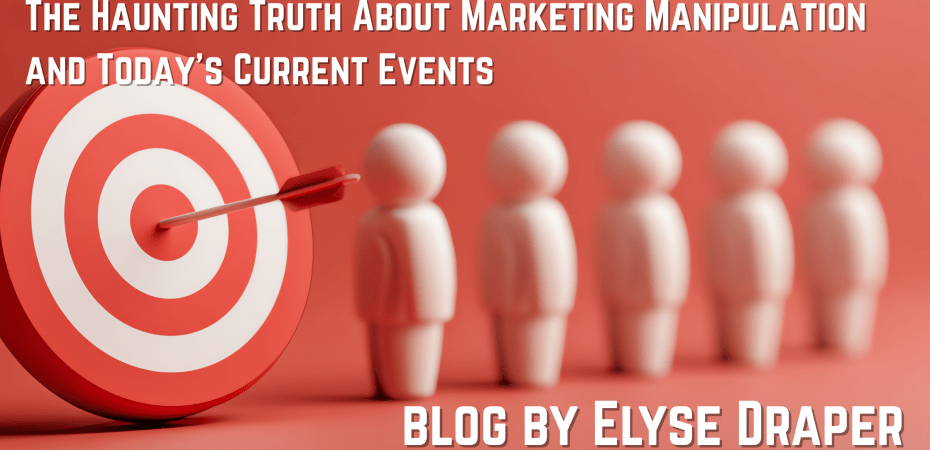
by Elyse Draper
Modern life often feels like navigating a marketplace saturated not just with products, but with competing narratives as well. The most unsettling realization of the 21st century is that the tactics used to sell a soft drink are now virtually indistinguishable from those used to sell a political candidate or a complex worldview.
This isn’t a simple analogy; it’s a haunting convergence where the atmosphere of media and politics has absorbed the fundamental, often manipulative, DNA of consumer marketing.
The Tyranny of the Algorithm
At the core of this convergence is the Attention Economy. Marketers, media outlets, and political operatives all operate under the same ruthless mandate: capture attention and hold it long enough to deliver the message.
The algorithm is the silent master of all three domains. For a brand, the algorithm ensures you see the perfect product advertisement. For a news feed, it ensures you see content designed to generate outrage, maximizing engagement time. For a political campaign, it micro-targets you with emotionally charged, often simplified narratives intended not to inform, but to confirm existing biases.
In politics, this results in campaigning driven by A/B testing—an advertising staple—where different versions of a message are tested on small segments of the population to see which triggers the strongest emotional response (anger, fear, or aspiration), regardless of its factual basis. The substance of policy fades behind the resonance of the brand identity.
Selling Aspiration, Not Policy
In traditional marketing, companies don’t just sell coffee; they sell the image of a focused, creative morning. They sell aspiration.
Politics functions identically now. Candidates are marketed not on dense policy platforms, but on a simplified, often mythological personal brand. They sell the voter an aspirational identity: If you vote for me, you are a member of this strong, authentic, or virtuous tribe.
This shift favors emotional and symbolic appeals over logic. This is why viral soundbites, bold logos, and carefully curated social media personas are often more potent than policy white papers. The political campaign becomes a high-stakes product launch, complete with focus groups, crisis management teams, and highly polished visual aesthetics.
The Echo Chamber as a Loyalty Program
The final, and perhaps most corrosive, point of overlap is the creation and maintenance of echo chambers.
For a company, creating an echo chamber is the goal of a robust loyalty program—to ensure the customer never sees or considers a competitor. They are happy within the brand bubble.
In the media and political landscape, algorithms create personalized realities that continuously reinforce citizens’ existing beliefs with information that validates their perspectives. Media outlets, driven by the need for clicks (a marketing metric), tailor their content to this reinforced reality. Political campaigns then exploit these closed loops, ensuring their base receives only confirming messages, deepening polarization and loyalty.
This means that a politician’s success is no longer about winning over the center, but about maximizing the engagement and “purchase rate” (i.e., vote) of the already committed consumer/voter.
The Consumer-Citizen’s Defense
The haunting truth is that the strategies perfected in the world of commerce—manipulation of attention, emotional exploitation, and the creation of insular consumer identities—have become the dominant strategies in public discourse.
To navigate this environment, the consumer-citizen must employ the same critical thinking skills in the ballot box as they do when evaluating a used car or a late-night infomercial. We must recognize the tactics, question the emotional trigger, and demand substance over the glossy, ephemeral packaging of a well-marketed idea.
 iPub Forum