
By Rabbi A. James Rudin
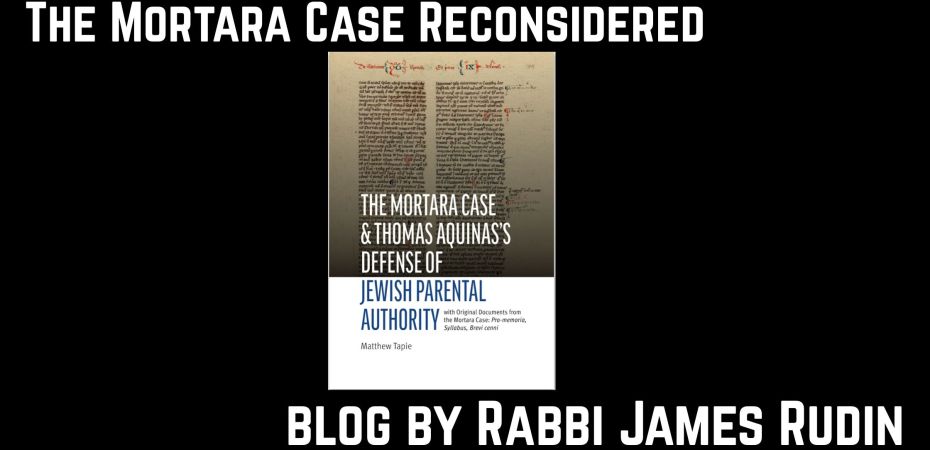
Dr. Matthew Tapie, a Saint Leo University Theology Professor and the Director of the SLU Center for Catholic-Jewish Studies, has recently published “The Mortara Case And Thomas Aquinas’s Defense of Jewish Parental Authority” (Catholic University Press of America, Washington DC).
Tapie’s book is a monumental achievement.
He builds upon Brown University Professor David Kertzer’s 1997 book, “The Kidnapping of Edgardo Mortara.” But, in addition to telling a painful narrative, Tapie also provides the reader with 174 pages of Italian and Latin language primary source material surrounding the infamous Mortara case. The book also contains a superb line- by- line English translation of the original texts. It is an amazing piece of scholarship.
What was the Mortara case that in 1858 pitted a defenseless Italian Jewish family against the secular and ecclesiastical might of the Vatican, led by Pope Pius IX?
Jews have lived continuously in Italy for more than 2,200 years, and they represent the oldest Jewish community outside the land of Israel. One of the population centers reflecting that proud ancient history is the university city of Bologna. During the mid-nineteenth century, the city was governed by Pius IX, who reigned as both the religious and secular ruler of the large Papal State that included Bologna.
In October 1857, the Vatican learned that Anna Morisi, a Catholic housekeeper employed by the Mortaras, a Jewish family with eight children, had secretly baptized the ill six-year-old Edgardo, whom she believed was near death. She feared Edgardo would die without a Catholic baptism that would ensure the little boy’s entry into heaven.
Because canon law and the civil law at that time required that a baptized child must be raised as a Catholic, in June 1858, Bologna’s ruler, Pius IX, ordered the physical removal of young Edgardo from his Jewish parents and his seven siblings.
It was a bitter and tearful moment when the youngster was publicly taken from his family and brought to Rome, where the pope personally raised the child as a very faithful Catholic.
Years later, Edgardo became an ordained priest and even sought to convert his own family to Catholicism, but he failed in that effort. He died at age 88 on March 11, 1940, in Liege, Belgium, just two months before the German invasion of that nation during World War II.
Had Father Mortara been taken prisoner by Hitler’s occupation forces, he would likely have been murdered because, for the Nazis, he was “racially” a Jew. The long-ago baptismal water would not have saved him during the Holocaust from the dreaded SS and Gestapo killers.
The Mortara case attracted enormous global attention and became an international cause celebre. The controversy shattered Catholic-Jewish relations, and it also hastened the collapse of papal political supremacy. In 1870, Italy became a republic, and the once potent power of the papacy was ended. The Vatican became solely the spiritual center of Roman Catholicism.
Edgardo’s distraught, grieving family and the Italian Jewish community demanded the return of the child to Momolo and Marianna, the boy’s biological parents. To strengthen that demand, they cited the theological teachings of Thomas Aquinas (1225-1274) considered then and now the most consequential Catholic theologian in history.
Even though Aquinas opposed the baptism of Jewish children “invitis parentibus” (against the will of the parents), the Vatican rejected the Mortaras’ appeal, asserting instead that Aquinas’s teaching actually validated Edgardo’s secret baptism.
Tapie’s book analyzes in detail which side accurately represents Aquinas’s beliefs, and how that answer impacts current Catholic theology and Catholic-Jewish relations today. Tapie weighs the various claims involved in the acrimonious debate and he presents the arguments found in the original Latin and Italian documents housed in Vatican Apostolic Archives as well as the various opinions used by both the Mortara family and the Vatican.
Tapie definitively proves that Aquinas’ teachings support the Jewish parental rights of the Mortara family and represent natural law. The Catholic theologian used a brilliant term to describe that position: “spiritualis uterus” or “spiritual womb.”
Tapie skillfully examines baptism “invitis parentibus” in the current Code of Canon Law and he calls attention to the Second Vatican Council’s 1965 “Nostra Aetate” declaration on religious freedom and the call for Catholics to develop strong and positive teachings about the Jewish people and Judaism.
Matthew Tapie has written a book for the ages.
Or to use language Aquinas would easily understand: “The Mortara Case And Thomas Aquinas’s Defense of Jewish Parental Authority” is a true “magnum opus,” a work of extraordinary scholarship that is certain to become a classic.
 iPub Forum