
An iPub Perspective Editorial
by Elyse Draper, Jennifer Wyman, and Kathleen Leaf
Did you know that Mental Health Awareness Month started in 1949? No? Have you ever wondered why Americans are so apathetic toward mental health? Have you ever thought to yourself, “The younger generation needs to toughen up. When I was a kid…”?
Why do we think such things? For older generations, why is it a point of pride to hide our emotions and ridicule those who broadcast them? We now know that the brain balances hormones, directly affected by our emotions, affecting our overall health. If there is no separation between mind and body, isn’t it logical to conclude that depression and anxiety are physical manifestations that are just as valid as a heart attack or broken bone? Yet, we have compassion for the heart attack or the broken bone, and we make sure they are immediately addressed. But, for some reason, we see mental illness very differently, somehow less significant. Too many people think that depression isn’t an illness, it’s a choice, and that anxiety doesn’t need treatment, it’s just a ploy for attention.

Why do other people’s emotions make us uncomfortable? Why do we have almost a Pavlovian response to internally jump directly to, “Stop talking about it.” For many, the response to displays of emotion is both automatic and visceral. We’re compelled to quash the outburst and bury it deeply. Could this be the reaction of social creatures who care about one another and are afraid to share each other’s pain?
We mumble as we squirm with awkwardness, “Just adapt and stop talking about it.”
The Covid 19 pandemic wasn’t the first time the US experienced increased societal mental health issues. For the past decade, suicide rates have been on the rise.
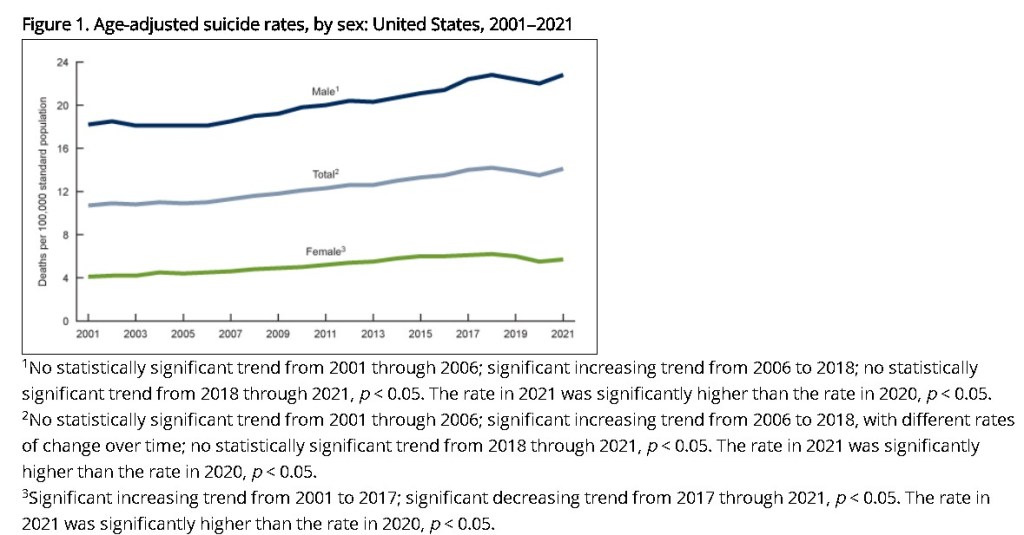
SOURCE: National Center for Health Statistics, National Vital Statistics System, Mortality.
Could social anxiety be a response when one’s survival is threatened? When basic needs such as food or shelter are threatened, isn’t anxiety an entirely understandable response? What happens when that anxiety becomes a generational norm? Could this be why there is a manifestation of transference, guilt, and defensiveness between the generations? If this response is passed down within a family, within a community, or within a nation, is it really an individual’s problem, or is it societal oppression that manipulates people to dismiss their own issues with the thought, “At least my neighbor has it worse”? Could this indifference be hurting our children?

Why are we showing our children that “feelings” are a weakness? When will we stop being so dismissive of our youth’s mental anguish? Why do we think “thou shalt not be infringed upon” is more vital than our children’s lives, fear, and mental health? How can we ignore, “Suicide is the second leading cause of death among young people aged 10 to 24 (Hedegaard, Curtin, & Warner, 2018) — and lesbian, gay, bisexual, transgender, queer, and questioning (LGBTQ) youth are at significantly increased risk. LGBTQ youth are not inherently prone to suicide risk because of their sexual orientation or gender identity but rather placed at higher risk because of how they are mistreated and stigmatized in society.”? Via the Trevor Project. Why do we ignore our children’s inalienable Rights to Life, Liberty, and the pursuit of Happiness? When did we forget that inalienable means something that “can’t be transferred to someone else, taken away, or denied?”
Have we looked at the opiate crisis, which has also been repeated throughout US history, as escapism from systemic mental health apathy? Have we considered the overprescribing from a medical institution that willfully ignores the mind’s chemical balance, emotional distress, or the essential need to address mental health? Why do some of us see addiction as a weakness of character rather than a mental illness that can be addressed?
Why do some people believe health issues and disabilities only affect the suffering individual? Why is suffering often “a you problem, not a me problem”? Why is this lack of empathy considered an entitlement and not its own mental health issue?
When did acknowledging and affirming the extreme sensation of societal despair become “Woke”? Could the root cause be the reality that most Americans are struggling to survive economically, medically, politically, racially, religiously, and socially? This societal despair threatens our very identities. This issue doesn’t care about political parties or dismissive arguments about snowflakes. These issues affect everyone, especially our children. We can no longer entertain the notion that this is “a you problem, not a me problem.”
This idea of the separation between mind and body was reinforced by the oversimplification of the 1960s and 1970s Anti-psychiatry campaign, which left us with a stigma that mental health is a societal perception rather than a legitimate medical problem. Via Oxford Academic article by Jonathan Toms. Why do we still believe in this antiquated idea?
It’s 2023, we are in pain, and our children suffer. If we want this to stop, we need to face our feelings like adults so that we can validate each other. Most importantly, we need to learn how to hear each other.
The answers to these questions can only be found once we acknowledge there is a problem and then engage in open dialogue with empathy and honesty. Consider this a challenge to prove that the idea of mental health isn’t defined by knee-jerk reactions, toxic ignorance, or systemic indifference; we are defining ourselves by how we treat each other and by how we care for one another.
In the meantime, help is available, and it’s easier to access than you might think.
American Psychological Association Crisis Hotlines and Resources.
Curious about what is being done to address our Nation’s Mental Health?Fact Sheet: Biden-Harris Administration Announces New Actions to Tackle Nation’s Mental Health Crisis
 iPub Forum
Reblogged this on Author Elyse Draper .
LikeLike