
by Joseph Stoutzenberger
Have you ever come across a term that you had never heard before, and then it keeps showing up multiple times afterward? That happened to me with the term “gaslighting.” I heard it on a talk show, then I read an article that used the term, and not long after that, the movie with that title was playing on TCM. It appears to mean, say an untruth often enough, and people start to believe it.
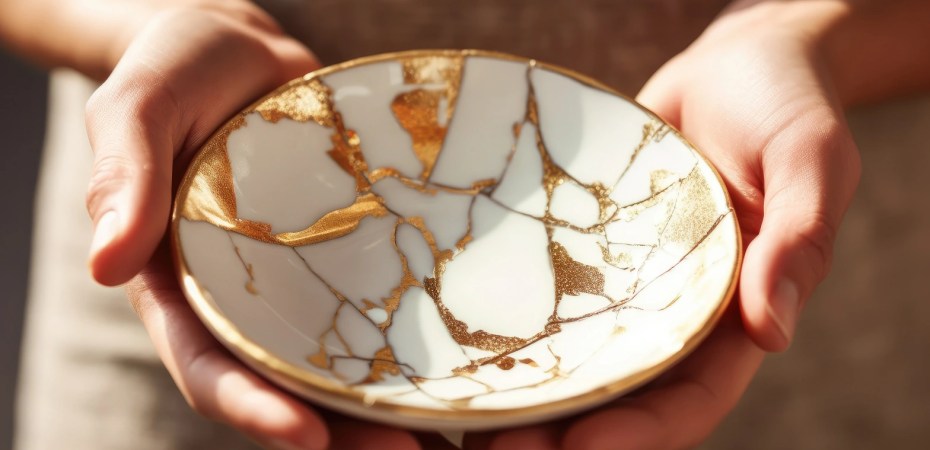
For me that experience happened with the term kintsugi. It refers to the Japanese art of repairing (tsugi) broken pottery with lacquer and gold (kin) so that the repaired pottery has new-found beauty, sometimes beyond what it originally had. Once I heard about the practice, I subsequently ran across references to it a few other times. It’s wonderful to hear about something ancient that offers new insight into the human condition.
That pottery repair practice certainly provides material for meditation applied to human life, similar perhaps to the well-known quote from Margery Williams’s The Velveteen Rabbit about becoming “real.”
“It doesn’t happen all at once…You become. It takes a long time. That’s why it doesn’t often happen to people who break easily, or have sharp edges, or who have to be carefully kept. Generally, by the time you are Real, most of your hair has been loved off, and your eyes drop out and you get loose in the joints and very shabby. But these things don’t matter at all, because once you are Real, you can’t be ugly, except to people who don’t understand.“

Years ago, I visited family of friends of mine in Taiwan. The host honored us by serving tea in a teapot that had been in her family for generations. The tea itself was also very old and rare. My first thought was, shouldn’t this pot be in a museum or kept untouched in a locked cabinet? Imagine if it broke while serving tea to a clumsy American such as myself! Then I realized that life doesn’t happen in museums and never-opened cabinets. Living, becoming real, always brings with it the danger of being broken. Kintsugi and The Velveteen Rabbit remind us that there is beauty in brokenness. The cracks and aching joints that come from giving ourselves to others, carrying around that helpless child all those years, and stepping out of our comfort zone to get involved when we would prefer to keep our distance, results in beauty beyond the pristine beauty of locked-away artifacts.
Traditional Christian theology says that “suffering is redemptive.” Jesus redeemed us through his suffering. I suggest a more accurate understanding is that Jesus gave himself out of love for others. That’s what was redemptive. Granted, his active care for others led to suffering; that’s the nature of life in the pursuit of becoming real. The central message of Christianity is that the love of God becomes real when it is poured out and broken. Those times when Jesus would have wanted to stay out of trouble, go off on his own, and mind his own business became redemptive because he put his life on the line instead. His giving of himself, which admittedly brought on suffering, gave a golden hue to his existence and to the brokenness of the world itself. Imagining God as a broken pot is not one that comes naturally. The cracks filled with gold are the tears, the emptying, the vulnerability, and the compassionate reaching out that results from getting involved and loving. That’s the “real” Christian God described in the bible and embodied most especially in the person of Jesus himself. We wouldn’t see the golden radiant beauty of God except for Christ on the cross.
 iPub Forum
thank you for a beautiful sentiment. I truly enjoyed reading this.
LikeLike
Joe,
What an excellent article! I love the comparison of the Velveteen Rabbit. We are all still becoming real, I feel until the day we meet Jesus, but what a wonderful opportunity we have to “become real” together with fellow believers and those not saved. Shine on Joe! You are making a difference in this world with your words!
LikeLike