
by Joe Stoutzenberger
Last week, when my wife and I boarded a local train, a conductor greeted us with a big smile, saying, “Welcome to the 9:01 train to Center City. Sit anywhere you like.” As the train began moving, I said to the conductor checking tickets and bundled up in winter clothes, “It’s supposed to warm up today.” She smiled and replied, “Sixty degrees by four o’clock. I can’t wait.”
A number of authors have recently written about the holiness and hope that can be found in the ordinary, in the everyday and commonplace, in encounters that we usually overlook or take for granted. My train experience was a moment in a train in a city on Earth, a speck in the vast universe. However, stepping back, it felt like the divine cosmic force behind the universe’s workings was actually at work in this seemingly insignificant event. The two conductors were not just moving the train; they were moving the hearts and uplifting the spirits of the passengers boarding and disembarking. Perhaps when Jesus told us, “God is love,” he had in mind the many kindnesses that people show one another, such as the cheerful exchange I had with two nameless train conductors.
Many contemporary theologians are coming to terms with insights from the Jesuit theologian and paleontologist Pierre Teilhard de Chardin, as well as information from modern physicists who recognize that the universe began over 13 billion years ago. A slow, evolutionary process led to the formation of planet Earth, and only recently to the life that distinguishes this lush, green planet. The human species evolved from less complex life forms. Teilhardians suggest that the spiritual core of human beings is not separate from humanity’s biological development but a wonderful expansion of the life force that has been growing and transforming over billions of years. That’s a challenging concept for Christians who are used to imagining that at some point when the human species arrived, God zapped an immortal soul into the first of its kind, call them Adam and Eve, and that this spiritual quality has been handed down to humans ever since.
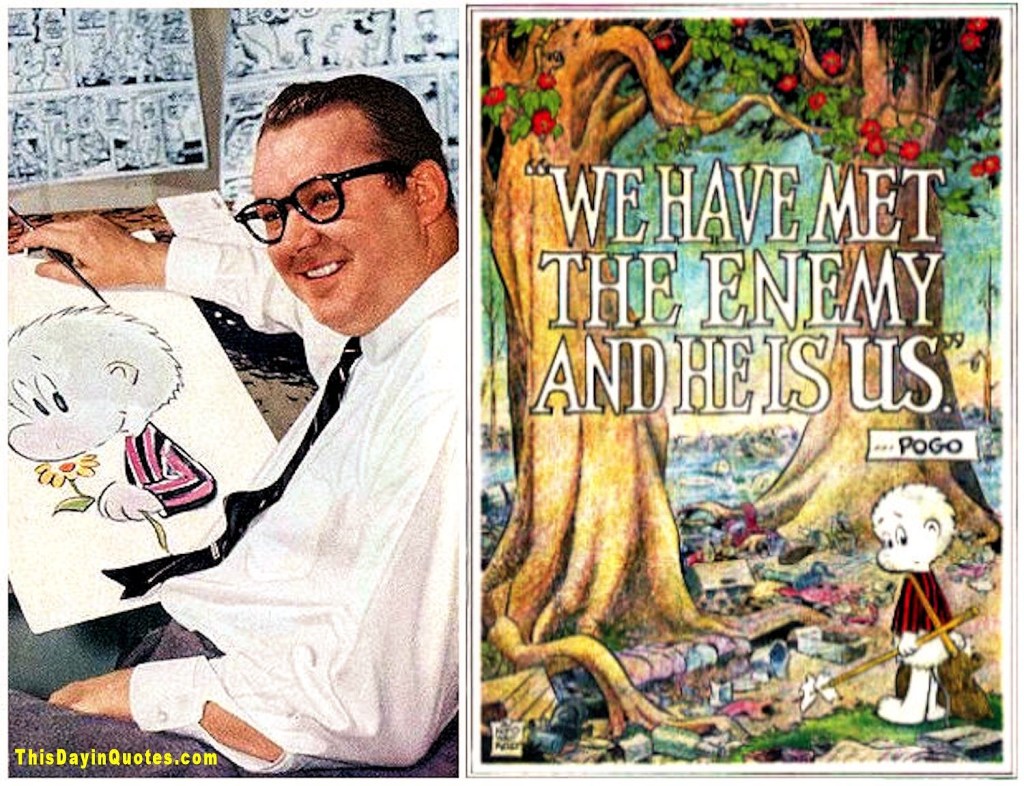
Photo credit: thisdayinquotes.com. Walt Kelly and his famous poster for the first Earth Day on April 20, 1970.
Whether or not we hold onto a more traditional theological understanding of human spirituality or the perspectives being put forth by these science-infused views on who and what we are as a species, one point of agreement exists: we are all interconnected. We are family. When Jesus said, “Love your enemy as yourself,” he was actually simply expressing what should be a natural response to the human condition. We have met the enemy, and they are us, as an early Earth Day poster proclaimed. To love them is to love ourselves. Teilhardians have added an important insight: we have evolved, and we continue to evolve. What we do today matters. We are helping to shape what it means to be human, one smile at a time or one nasty comment at a time. When Christians pray that God’s will be done, it’s meant to be a pact, a covenant, to which we commit ourselves. Our treatment of other people and of other creatures shapes the ongoing development of life on our planet and beyond. Either we work toward furthering God’s kingdom on earth, or we don’t. No one is a bystander.
Some Philadelphia train conductors spend their Sundays praising God in church services. They leave the church with a renewed commitment to being the church in their everyday work. I, for one, am grateful for that. We are all in this together, and together we are shaping the future. We all participate in this universe-shaping project. His studies of the universe’s workings led Teilhard to urge us to “harness for God the energies of love.” It is, he reminds us, the slow work of God, but our only hope, one train ride at a time.

