
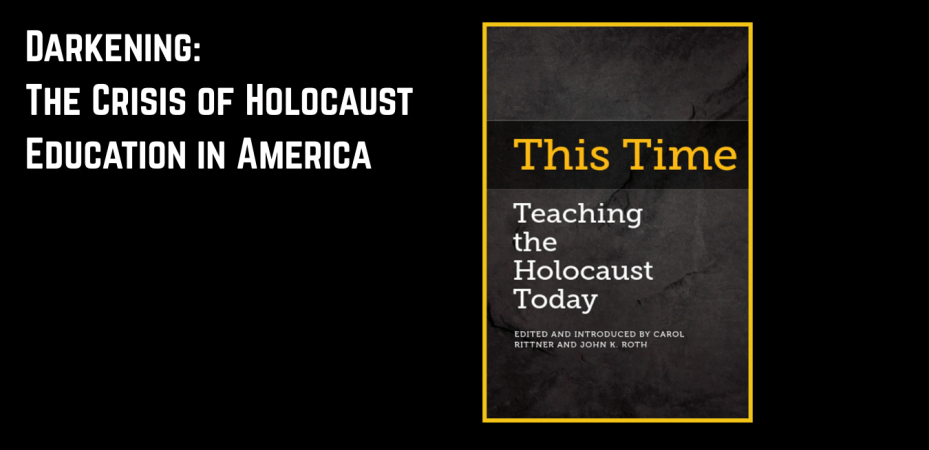
EDITOR’S NOTE: This post is a condensed adaptation of the introduction from This Time by Carol Rittner and John K. Roth, generated with AI assistance. No new content has been added.
When the United States Holocaust Memorial Museum (USHMM) opened its doors in Washington, DC, in April 1993, the era was one of optimism for liberal democracy. The Cold War had ended, the Berlin Wall had fallen, and there was a sense that the lessons of the Holocaust could serve as a “never again” bulwark for a more enlightened world. But as editors Carol Rittner and John K. Roth argue, that era has ended.
“The landscape has changed,” they write. “The darkening that characterizes ‘this time’ is multifaceted. Its shadows include the continued, even expanding, resonance of the ‘big lie’—the claim that the 2020 US presidential election was stolen—and the Jan. 6, 2021, insurrection at the US Capitol. These events, and the political movements that sustain them, are not merely ‘politics as usual.’ They represent a fundamental challenge to the democratic institutions and values that Holocaust education has long sought to defend.”
For decades, Holocaust education in the United States often focused on the “other”—on a distant European past or on foreign dictatorships. It was taught with the implicit assumption that “it can’t happen here.” Rittner and Roth suggest that this assumption is no longer tenable. They point to the rise of Christian nationalism, white supremacy, and a brand of authoritarianism that increasingly mirrors the early stages of the Weimar Republic’s collapse.
“Holocaust education,” they argue, “has often been a way for Americans to feel good about themselves by identifying with the liberators of the camps while ignoring the antisemitism, racism, and xenophobia in their own history. In ‘this time,’ that luxury is gone. We must ask: What does it mean to teach the Holocaust when the very people we are teaching are living in a society where the guardrails of democracy are being dismantled?”
What does it mean to teach the Holocaust when the very people we are teaching are living in a society where the guardrails of democracy are being dismantled?
The editors challenge educators to move beyond the “sanitized” version of Holocaust history. They suggest that the “this time” of the book’s title refers to a moment of extreme urgency. “If we continue to teach the Holocaust as a closed chapter of history, we fail. ‘This time’ demands that we recognize the fragility of our own institutions. It requires us to look at the Nazi rise to power not as an inevitable march of monsters, but as a series of choices made by ordinary people in a democracy that failed to protect itself. When we see similar rhetoric—the dehumanization of immigrants, the attacks on the press, the calls for political retribution—used in our own public discourse, we can no longer remain neutral. Teaching the Holocaust today is a civic act of resistance against the rising tide of authoritarianism.”

