
by James Rudin
Israel’s first Prime Minister, David Ben-Gurion (1886-1973), gives new meaning to the Latin phrase – carpe diem – seize the day. That is just what “B-G” did when he proclaimed the independence of the State of Israel in Tel Aviv 78 years ago on May 14, 1948.
The now-or-never philosophy of Israel’s “founding father” was in full display that day when Ben-Gurion confidently stepped out of a Lincoln sedan and proudly saluted the waiting crowd before striding into the Tel Aviv Museum, where he read aloud the Hebrew text of the new state’s Declaration of Independence.
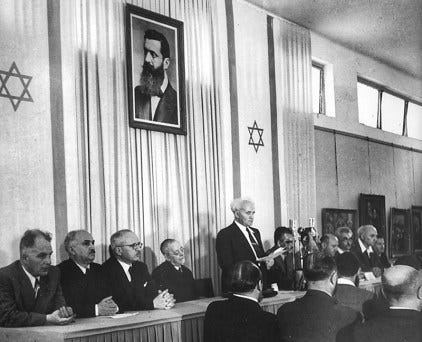
Photo credit: David Ben-Gurion reading the Israeli Declaration of Independence on 5/14/48. Credit: Wikipedia
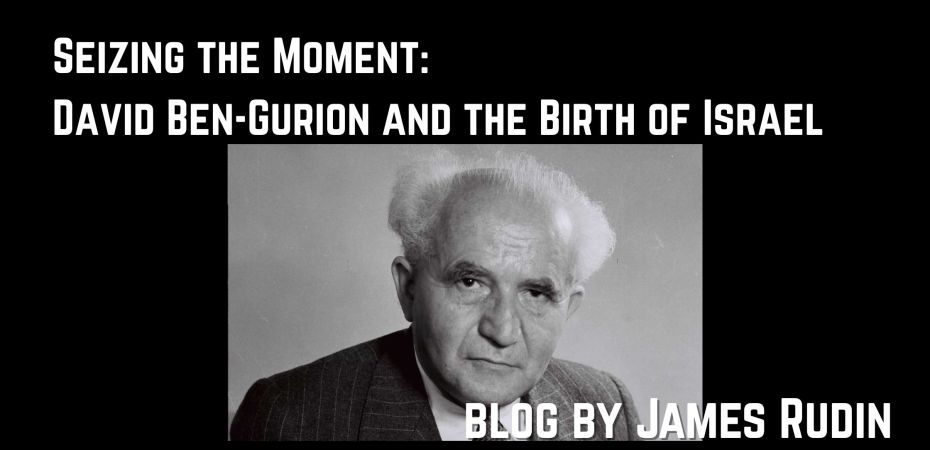
Ben-Gurion was a short, pudgy man with two tufts of white hair protruding from his large, balding head. As he entered the Museum, he carried a briefcase, presumably containing the Declaration of Independence, which he had personally rewritten the night before because he was dissatisfied with the original draft written by a colleague.
Ben-Gurion’s confident salute signaled to a skeptical world his steely resolve in the face of opposition from President Harry Truman’s top two cabinet members: Secretary of State George C. Marshall and Secretary of Defense James V. Forrestal, misgivings also voiced by his more cautious comrades, as well as the threat of an imminent war with better-equipped Arab armies.
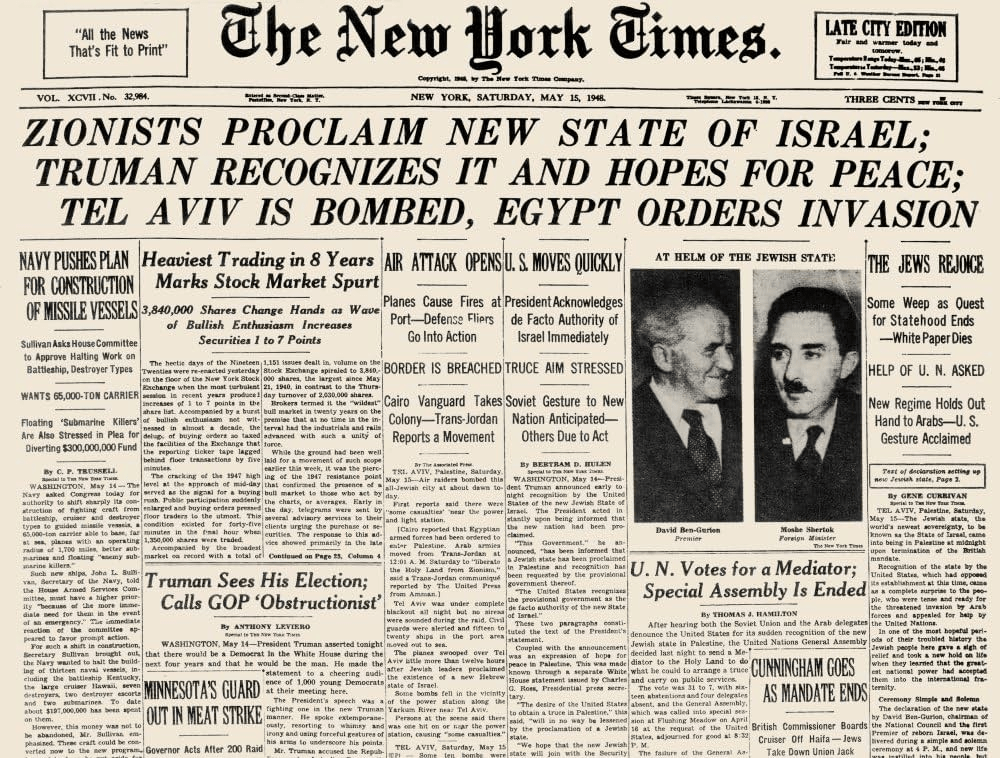
Photo Credit: The New York Times’ front page from May 15, 1948, declaring the creation of the modern Israel and Truman’s recognition of it. Photo Courtesy of Beth Harpaz
In his pursuit of a sovereign state at any cost, Ben-Gurion had rejected every alternative solution, whether a bi-national Arab-Jewish state or federation, autonomous Jewish areas, geographically separated cantons, an internationally administered mandate, or a U.N. trusteeship.
B-G was a complex man who was personally aloof, often depressed, mean-spirited, indifferent to his wife and three children, and a relentless adversary of many other prominent Israeli leaders, especially Chaim Weizmann, Levi Eshkol, and Menachem Begin.
Ben-Gurion believed that Weizmann, living in England for decades prior to 1948, was too enamored of Britain’s ruling “Establishment” that reneged on the promises of its 1917 Balfour Declaration, which called for the establishment of a “Jewish national home” in Palestine. Despite Ben-Gurion’s hostility, Weizmann became Israel’s first President.
On the eve of the victorious 1967 Six-Day War, Ben-Gurion predicted that the weak Prime Minister Eshkol “… will descend (Israel) into perdition.” Menachem Begin, who became Israeli PM in 1977, was Ben-Gurion’s longtime ideological opponent on the right.
Born David Gruen, the future prime minister left his native Poland for Ottoman Turkish-controlled Palestine in 1906 at the age of 20 to pursue his lifelong goal: the creation of an independent state with a large Jewish majority. But Ben-Gurion was under no illusion that accomplishing this goal would result in an armed conflict, inflicting many deaths and much suffering on both sides.
He envisioned a Jewish state with a population of several million Ashkenazi Jews, like himself, whom he considered far better “physical material” than Jews from North Africa and the Middle East. But the murder of six million mostly Ashkenazi Jews in the Holocaust ended that dream. After 1948, Ben-Gurion came to accept the reality that a Jewish majority in the newly independent Israel could only be achieved through mass Jewish immigration from Iraq, Morocco, Egypt, Libya, Yemen, and other dominantly Muslim countries that had become hostile, or at best inhospitable, to Jews after Israel became an independent state.
Ben-Gurion, the acknowledged leader of the 600,000 Jews living in British Mandate Palestine in 1948, had personally raised millions of dollars from wealthy Americans, mostly for armaments and to fund the underground campaign to circumvent the British naval blockade that was preventing Holocaust survivors from reaching “Eretz Yisrael,” the historic biblical homeland of the Jewish people.
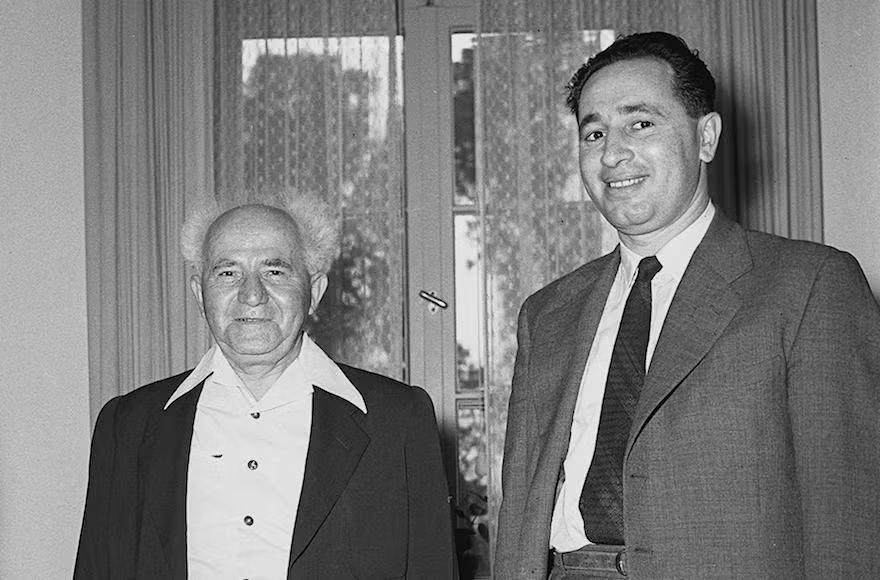
Photo credit: Shimon Peres, right, then director general of the Defense Ministry, with then-Defense Minister David Ben-Gurion in 1955. (Israeli Government Press Office/Flash90)
Today, Ben-Gurion is often criticized for the Haganah’s (the “official” forerunner of the Israel Defense Forces) unpreparedness during the 1948 War of Independence, but the same critics also praise him for effective military leadership during that war. Much of that credit also goes to Ben-Gurion’s young associate and future Prime Minister Shimon Peres, who succeeded in obtaining from several European nations the weaponry desperately needed by the fledgling state to prevail.
B-G was a long-serving prime minister who pressed for the Adolf Eichmann trial in Jerusalem, the Ben-Gurion/Konrad Adenauer relationship that brought West Germany and Israel together after the Shoah (Holocaust), and much, much more.
Even when one strips away the patina of hero worship, David Ben-Gurion’s extraordinary achievements will forever reveal a formidable, single-minded determination that led to the creation and independence of the world’s only Jewish state.

