
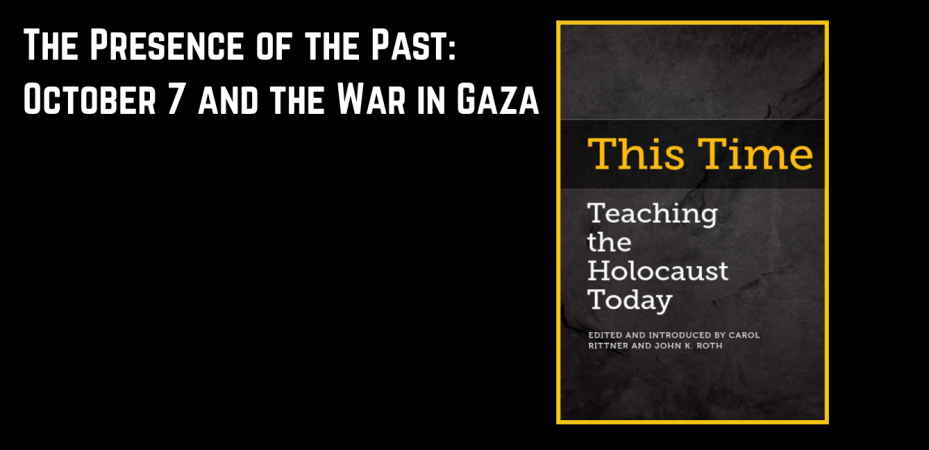
EDITOR’S NOTE: This post is a condensed adaptation of Chapter 9: The Presence of the Past from This Time, written by Edward B. Westermann, and edited by Carol Rittner and John K. Roth, generated with AI assistance. No new content has been added.
In the aftermath of October 7, 2023, the world was thrust into a debate over the “uniqueness” of the Holocaust and its relationship to modern conflict. In his contribution to This Time, historian Edward B. Westermann explores the concept of “performative violence” and how it links the atrocities of the Nazi era to the current violence in the Middle East.
Westermann, known for his work on the “drunkenness of violence” among Nazi killers, notes a chilling parallel in the celebratory nature of the violence committed during the Hamas attacks. “One of the most disturbing aspects of the Holocaust,” Westermann writes, “was not just the scale of the killing, but the ritualized, often celebratory nature of the violence. Nazi perpetrators often photographed their crimes, sent souvenirs home, and turned the slaughter of innocents into a spectacle. On October 7, we saw a digital version of this performative violence. The use of body cams and social media to broadcast the torture and murder of civilians in real-time echoes the ‘festive’ atmosphere found in some of the darkest chapters of the Holocaust.”
However, Westermann also tackles the secondary, equally fraught challenge: the charges of genocide leveled against Israel in its subsequent military campaign in Gaza. He notes that “this time” creates an unprecedented pedagogical challenge for Holocaust educators. “For years, the Holocaust has been the gold standard for ‘evil.’ Now, we see that terminology—’genocide,’ ‘concentration camp,’ ‘Nazism’—being weaponized by both sides of the Israel-Hamas conflict. This creates a minefield for the classroom.”
He argues that the task of the educator is not to simplify these comparisons, but to demand historical precision. “To call Gaza a ‘concentration camp’ or to label the IDF as ‘Nazis’ is a form of Holocaust distortion that ignores the specific intent and infrastructure of the Final Solution. At the same time, to ignore the humanitarian catastrophe in Gaza or the rhetoric of dehumanization used by some political leaders is to ignore the very lessons of empathy and human rights that Holocaust education is supposed to instill.”
Westermann concludes that teaching “this time” requires a willingness to sit with discomfort. “The presence of the past is not a straight line. It is a haunting. We see the ghosts of the Holocaust in the Kibbutzim of southern Israel, and we see the echoes of historical suffering in the ruins of Gaza. The challenge for educators is to prevent the Holocaust from becoming a mere political cudgel. We must use the history of the 1930s and 40s to sharpen our moral vision, not to blind us to the complexities of the present. If we cannot talk about October 7 and Gaza in the same breath as the Holocaust without collapsing into polemics, then we have failed to learn what the Holocaust actually has to teach us about the fragility of the human condition.”
 iPub Forum