
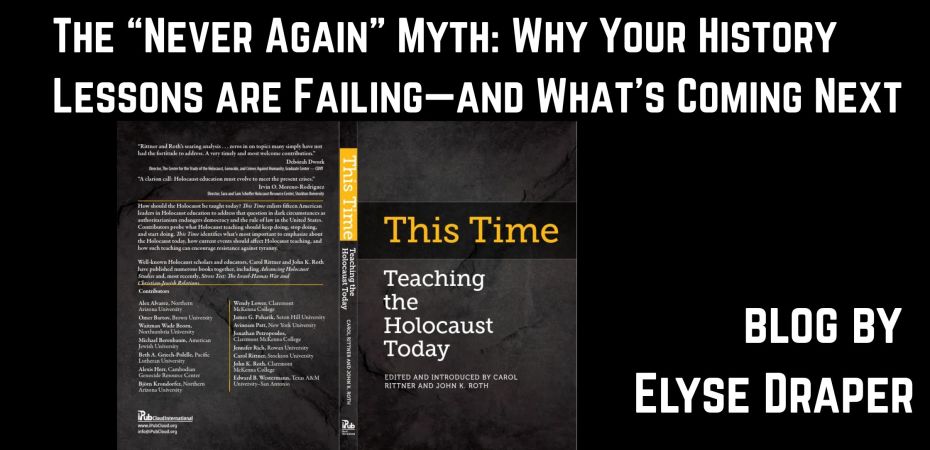
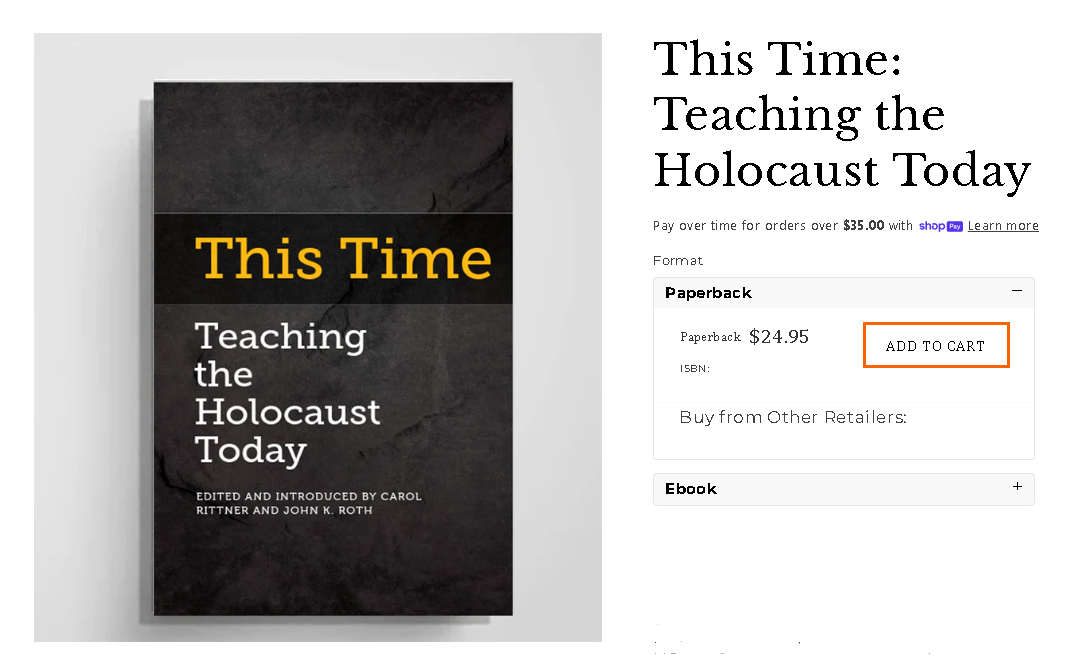
Book Review for “This Time: Teaching the Holocaust Today.”
by Elyse Draper
We have been lied to. For decades, the mantra “Never Again” has been treated as a comforting lullaby, a promise that the horrors of the 1940s were a one-time aberration, a “glitch” in the matrix of Western progress. We built the museums, we watched the documentaries, and we told ourselves we were immune.
We were wrong.
The newly released volume, This Time: Teaching the Holocaust Today, isn’t just a book of history—it’s a survival manual for a collapsing present. It argues that if you are waiting for the cattle cars to arrive before you start worrying about democracy, you’ve already lost.
The 1930s are Happening Now
The contributors to This Time make a chillingly provocative case: We must stop obsessing over the 1940s and start panicking about the 1930s. The Holocaust didn’t start with gas chambers; it started with the “Authoritarian Playbook”—a set of strategies that are being mirrored with terrifying precision in modern America.
From the demonization of immigrants as “vermin” who are “poisoning the blood of our country,” to the promise of a “Golden Age” that requires the purging of “enemies,” the rhetoric is no longer a historical curiosity. It is our daily news cycle. The book identifies the “Make America Great Again” (MAGA) agenda as a modern iteration of this ancient siren song: a utopian promise of national restoration that requires the systematic dehumanization of the “other.”
Coup-Proofing and the Death of Truth
The “Authoritarian Playbook” isn’t just about mean words; it’s about the surgical dismantling of the rule of law. This Time highlights the contemporary rise of “coup-proofing”—the purging of competent government officials in favor of “yes-men” who prioritize personal loyalty over the Constitution.
We see it in the defense of masked, unidentifiable agents on our streets. We see it in the use of “emergency decrees” to bypass civil liberties. We see it in the selective use of pardons to reward those who commit crimes in the leader’s name. This isn’t politics as usual; it is the infrastructure of tyranny being built in broad daylight.
Education as Resistance
Perhaps most dangerously, the playbook targets our schools. By banning books, restricting discussions on systemic racism, and demanding “opposing views” for established historical facts, the state is attempting to enforce a “single story.” They don’t want your children to think critically; they want them to obey.
This Time positions the act of teaching as a form of resistance. It argues that Holocaust education must evolve. It can no longer be a passive exercise in mourning; it must be a critical defense of truth and human rights. To teach the Holocaust today is to hold up a mirror to our own border policies, our own rhetoric, and our own indifference.
The Choice
As the generation of living witnesses disappears, we are left with a choice. We can continue to treat the Holocaust as a distant tragedy, or we can recognize it as a recurring threat.
This Time: Teaching the Holocaust Today is a warning shot. It tells us that history is not a straight line of progress—it is a circle. And right now, we are rounding a very dark corner.
Will you look away, or will you learn how to fight back?
Works Cited
- This Time: Teaching the Holocaust Today (Press Kit, March 30, 2026).
- “The Authoritarian Playbook: Strategies of Consolidation and Marginalization.” This Time: Teaching the Holocaust Today, edited volume, 2026.
- “The Danger of the Single Story in Modern U.S. Education.” This Time: Teaching the Holocaust Today, 2026.
- “From the Reichstag to the Border: The Use of Emergency Decrees.” This Time: Teaching the Holocaust Today, 2026.
Author’s Note: Article written alongside NotebookLM AI Teaching Assistant


This certainly sounds like an essential read. It is not only the good seed that awaits an opportune time to spring back to life. So does the bad seed.
LikeLiked by 1 person